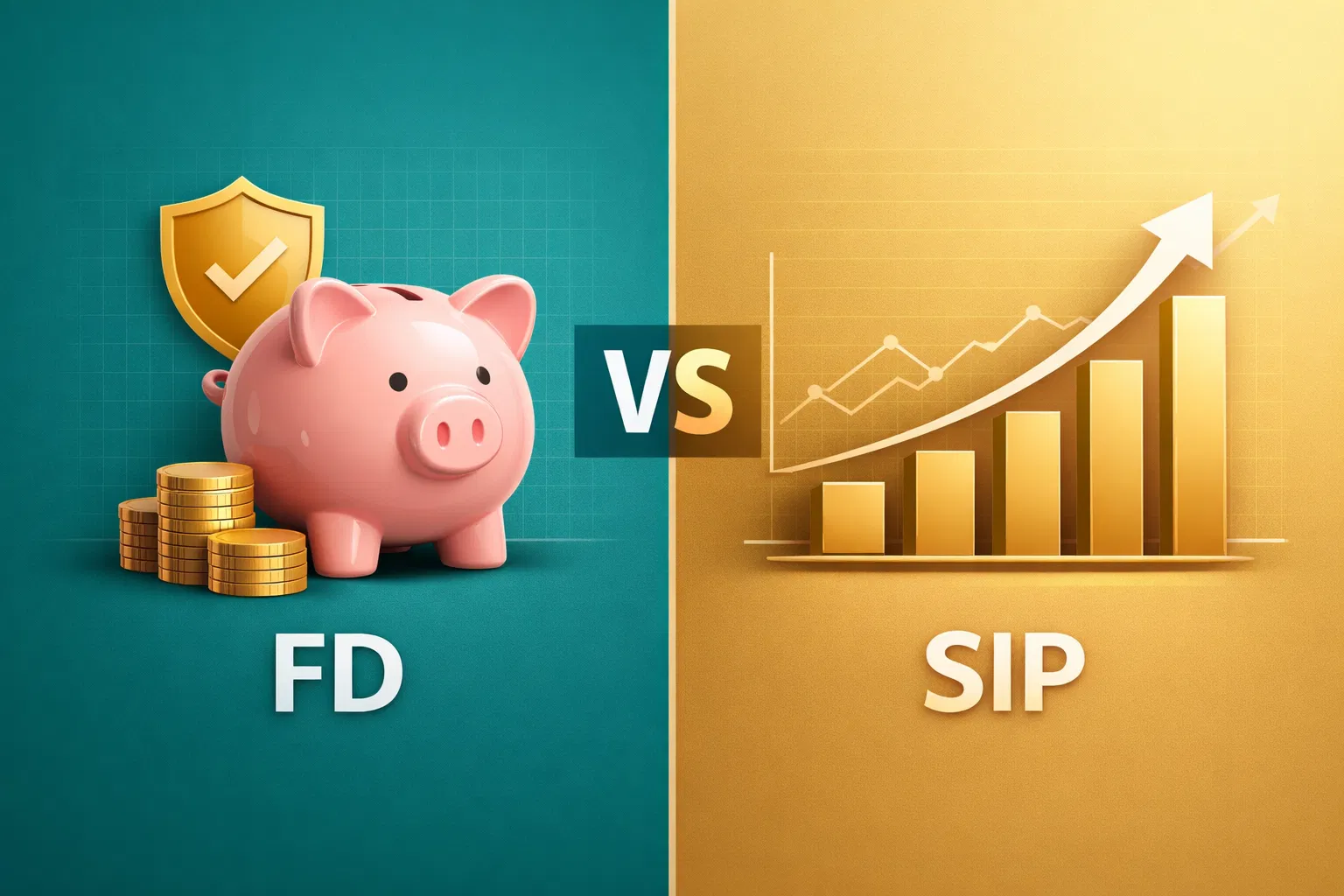
SIP vs FD: Which is Better for Students?
When students start thinking about investing, they often compare SIP (Systematic Investment Plan) and FD (Fixed Deposit). Both are good options, but they serve different purposes.
What is an FD?
A Fixed Deposit is a savings product offered by banks. You give the bank a lump sum of money for a fixed period (like 1 year or 5 years), and they pay you a fixed interest rate. When the period ends, you get your money back plus interest. FDs are safe and guaranteed.
What is a SIP?
A Systematic Investment Plan is a way to invest in mutual funds. You invest a fixed amount regularly (like ₹500 per month) into a mutual fund. The fund manager invests your money in stocks, bonds, or other securities. Your returns depend on how well the fund performs.
Safety: FD vs SIP
FDs are safer because they're backed by the bank and guaranteed by the government (up to ₹5 lakh). You know exactly how much money you'll get back. SIPs are riskier because stock markets fluctuate. However, over long periods (5+ years), SIPs have historically delivered better returns than FDs.
Returns: FD vs SIP
Current FD rates are around 6-7% per year. This is fixed and guaranteed. SIPs have historically returned 10-12% per year on average, but with volatility. In some years, SIPs might return 20%, while in other years they might lose 5%. Over long periods, SIPs typically outperform FDs.
Liquidity: FD vs SIP
FDs lock your money for a fixed period. If you need money before maturity, you'll face penalties. SIPs are more flexible—you can withdraw money anytime, though you might face some charges. For students, flexibility is important, so SIPs have an advantage here.
Time Horizon
If you need money in 1-2 years, FD is better. If you have a 5+ year time horizon, SIP is better. As a student, you likely have a long time horizon before you need this money, making SIP more suitable.
Effort Required
FDs require minimal effort—you deposit money and wait. SIPs require you to monitor your investments and understand the market. For students willing to learn, SIPs are better. For those who want a hands-off approach, FDs are better.
Tax Implications
Interest from FDs is fully taxable as income. Long-term capital gains from SIPs (held for 1+ year) are taxed at lower rates. This tax advantage makes SIPs more efficient for wealth building.
The Best Strategy
Many financial experts recommend a combination approach. Use FDs for money you need in the short term (1-2 years). Use SIPs for long-term wealth building (5+ years). As a student, you could start with a small FD for emergency funds and use SIPs for long-term investing.
Conclusion
Both SIP and FD have their place in your investment portfolio. For students with a long time horizon, SIPs are generally better because they offer higher returns and more flexibility. However, if you prefer safety and guaranteed returns, FDs are a good option. Consider your goals, time horizon, and risk tolerance when deciding.
Related Articles
How to Start Investing with ₹500: A Beginner's Guide
Learn how to start investing with just ₹500 and build wealth from a young age.
How Students Can Build Wealth Early: A Long-Term Strategy
Learn a comprehensive strategy for building wealth starting from your student years.